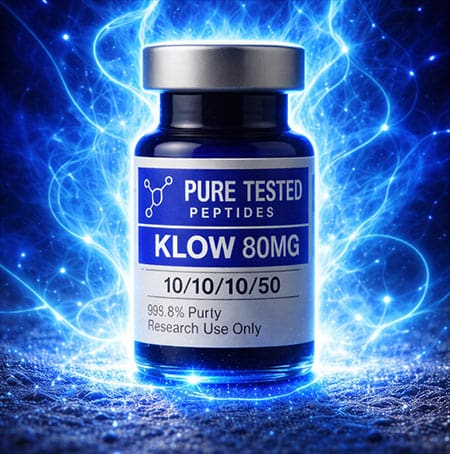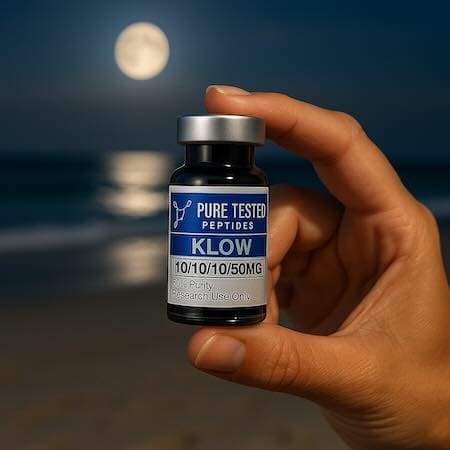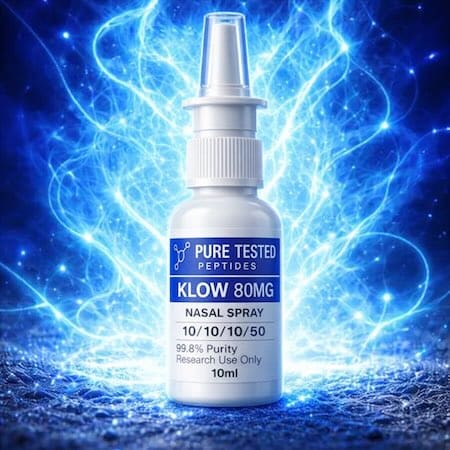
Description Klow Nasal Spray Kit | Complete Recovery Stack | BPC-157 TB-500 GHK-Cu KPV | 80mg Advanced 4-Peptide Blend with Immune Modulation for Comprehensive Recovery Research | Third-Party Tested | USA Product Specifications Blend Composition: BPC-157: 10mg (Body Protection Compound) TB-500: 10mg (Thymosin Beta-4) GHK-Cu: 50mg (Copper Peptide) KPV: 10mg (Lys-Pro-Val Tripeptide) Total Content: 80mg peptides Purity: Each component ≥98-99% (HPLC) Format: Lyophilized powder Storage: -20°C (freezer) ✓ Third-Party Tested ✓ Made in USA ✓ Same-Day Shipping ✓ 4 COAs Included ✓ For Research Use Only What is the Complete Recovery Stack? The Complete Recovery Stack represents the next evolution in peptide blend research, building upon the foundation of the 3-peptide Skin Repair Stack by adding KPV (lysine-proline-valine), a potent anti-inflammatory and immune-modulating tripeptide. This 4-peptide combination provides comprehensive coverage of all major tissue repair pathways: angiogenesis, cell migration, matrix remodeling, and immune/inflammatory regulation. Why Add KPV? The Fourth Mechanism While the first three peptides address structural repair (vascular, cellular, matrix), KPV adds a critical fourth dimension: immune modulation and inflammation control. Tissue repair doesn’t occur in a vacuum—the inflammatory environment determines whether healing is efficient and organized or prolonged and fibrotic. KPV’s ability to modulate NF-κB signaling and inflammatory pathways makes this stack particularly valuable for: Inflammatory condition research (colitis, arthritis models) Gut health and intestinal barrier studies Conditions where excessive inflammation impairs healing Research on resolution phase of inflammation KPV Peptide: The Immune Modulation Component What is KPV? KPV (Lysine-Proline-Valine) is a C-terminal tripeptide fragment of α-MSH (alpha-melanocyte-stimulating hormone), a neuropeptide with profound anti-inflammatory and immunomodulatory properties. While α-MSH has 13 amino acids, KPV comprises just the final three—yet retains potent anti-inflammatory activity without the melanogenic (tanning) effects of the full peptide. Molecular Specifications: Sequence: Lys-Pro-Val (tripeptide) Molecular Formula: C₁₆H₃₀N₄O₄ Molecular Weight: 342.43 g/mol Origin: Derived from α-MSH (amino acids 11-13) KPV Mechanism of Action 1. NF-κB Pathway Inhibition (Primary Mechanism) KPV’s most well-characterized mechanism is inhibition of NF-κB (nuclear factor kappa-light-chain-enhancer of activated B cells), the master regulator of inflammation: Cellular Entry via PepT1: KPV enters inflamed cells through PepT1 transporter (oligopeptide transporter 1) Nuclear Translocation Block: Prevents NF-κB translocation from cytoplasm to nucleus Transcription Inhibition: Blocks NF-κB-mediated transcription of pro-inflammatory genes Cytokine Reduction: Decreases IL-1β, IL-6, TNF-α, IL-8 production 2. Gut Health & Intestinal Barrier KPV has shown particular efficacy in gastrointestinal research: Inflammatory Bowel Disease Models: Reduces severity in mouse colitis models Barrier Function: Preserves tight junction integrity (occludin, ZO-1 proteins) Mucosal Healing: Promotes epithelial repair in damaged intestine Microbiome: May influence gut microbiota composition 3. Antimicrobial Properties KPV exhibits direct antimicrobial effects: Broad Spectrum: Active against gram-positive and gram-negative bacteria Candida Activity: Inhibits fungal growth (C. albicans) Biofilm Disruption: Penetrates bacterial biofilms Wound Infection: Reduces bacterial burden in infected wounds 4. Mitochondrial Function Emerging research suggests KPV supports mitochondrial health: Enhances oxidative phosphorylation efficiency Reduces mitochondrial ROS production Improves cellular energy status (ATP production) Why KPV Instead of Full α-MSH? Full α-MSH activates all five melanocortin receptors (MC1R-MC5R), including MC1R which causes melanogenesis (tanning). KPV retains anti-inflammatory activity without melanogenic effects, making it more specific for inflammation research. Additionally, as a tripeptide, KPV is smaller (342 Da vs 1,665 Da), more stable, and easier to synthesize than full α-MSH. Four-Pathway Synergy: Complete Recovery Mechanisms Pathway 1: Angiogenesis (BPC-157) Function: Vascular supply and oxygen delivery BPC-157 establishes the vascular network necessary for healing through VEGF upregulation, NO pathway modulation, and endothelial cell recruitment. Pathway 2: Cell Migration (TB-500) Function: Population of repair site with necessary cells TB-500’s actin-binding properties enable keratinocytes, fibroblasts, and immune cells to efficiently migrate into healing tissue along vascular networks. Pathway 3: Matrix Remodeling (GHK-Cu) Function: Organized tissue architecture GHK-Cu directs collagen synthesis, crosslinking, and organization while regulating 4,000 genes toward pro-repair profiles. Pathway 4: Immune Modulation (KPV) Function: Inflammatory balance and resolution KPV prevents excessive inflammation that would impair healing while maintaining adequate immune response for pathogen clearance and tissue remodeling. The Four-Phase Recovery Cascade Phase 1 – Hemostasis & Early Inflammation (Hours 0-24): KPV modulates initial inflammatory response, preventing excessive damage while BPC-157 initiates angiogenesis Phase 2 – Proliferation (Days 1-14): TB-500 facilitates cell migration, BPC-157 expands vascular network, GHK-Cu begins collagen deposition, KPV maintains controlled inflammation Phase 3 – Remodeling (Days 7-28): GHK-Cu organizes matrix structure, TB-500 maintains tissue flexibility, BPC-157 ensures vascular support, KPV promotes resolution of inflammation Phase 4 – Maturation (Days 21 ): GHK-Cu continues matrix refinement, all peptides support tissue homeostasis, KPV prevents fibrotic transformation Research Applications: Complete Recovery Stack Inflammatory Bowel Disease (IBD) Research The Complete Recovery Stack is particularly well-suited for IBD models: DSS-Induced Colitis: KPV reduces inflammatory markers, BPC-157 heals mucosa, TB-500 enhances epithelial migration TNBS Colitis: Comprehensive healing of chemical-induced intestinal damage Crohn’s Models: Transmural healing supported by all four mechanisms Ulcerative Colitis: Mucosal repair with reduced relapse potential Wound Healing with Inflammatory Complications Infected Wounds: KPV’s antimicrobial properties plus structural repair Diabetic Wounds: Addresses both impaired healing and excessive inflammation Burn Injuries: Controls hyperinflammatory response while promoting regeneration Pressure Ulcers: Comprehensive repair in ischemic, inflamed tissue Autoimmune & Inflammatory Conditions Arthritis Models: Joint inflammation control with cartilage protection Dermatitis: Skin barrier repair with immune modulation Psoriasis Models: Keratinocyte regulation and inflammation reduction Tissue Inflammation: Any model where inflammation impairs repair Mitochondrial & Energy Metabolism Research Cellular Bioenergetics: KPV and GHK-Cu both support mitochondrial function Metabolic Syndrome Models: Addressing inflammatory component of metabolic disease Aging Research: Multi-system approach to age-related decline Comparative Research Opportunities 4-Peptide vs 3-Peptide: Quantify added value of KPV With vs Without Immune Modulation: Role of inflammation in healing outcomes Acute vs Chronic Inflammation Models: Stack efficacy across inflammatory contexts Component Subtraction Studies: Determine essential vs optional components Reconstitution & Research Dosing Reconstitution Protocols Option 1: Separate Reconstitution (Maximum Flexibility) BPC-157 (10mg): 2mL bacteriostatic water = 5mg/mL TB-500 (10mg): 2mL bacteriostatic water = 5mg/mL GHK-Cu (50mg): 5mL bacteriostatic water = 10mg/mL KPV (10mg): 2mL bacteriostatic water = 5mg/mL Option 2: Combined Reconstitution If pre-mixed (80mg total): Add 8mL bacteriostatic water for 10mg/mL concentration Research Dosing Framework Standard Protocol (Separately Reconstituted): Daily Administration: BPC-157: 250-500 µg daily TB-500: 2-5 mg twice weekly (or 750 µg daily equivalent) GHK-Cu: 1-3 mg daily KPV: 500 µg – 2 mg daily Inflammatory Condition Protocol: For IBD models or high-inflammation conditions: BPC-157: 500-750 µg daily (oral possible for GI) TB-500: 5 mg twice weekly GHK-Cu: 2-3 mg daily KPV: 2-5 mg daily (higher dose for inflammation control) Gut Health Research Protocol: Oral Administration: BPC-157 and KPV can be administered orally for direct gut effects Topical (Colon): Enema formulations can deliver peptides directly to inflamed tissue Systemic: Subcutaneous injection for systemic effects Administration Routes by Research Focus Research Focus Preferred Route Rationale Wound Healing Subcutaneous near site Localized delivery with systemic benefits IBD/Colitis Oral SC combination Direct mucosal systemic effects Skin Conditions SC topical GHK-Cu Combined systemic and dermal approach Systemic Inflammation Subcutaneous Broad distribution to all tissues Sample 8-Week IBD Research Protocol Week 1-2 (Acute Phase): BPC-157: 500 µg oral 500 µg SC daily TB-500: 5 mg SC twice weekly GHK-Cu: 3 mg SC daily KPV: 5 mg oral daily (divided doses) Week 3-8 (Maintenance/Healing): BPC-157: 250-500 µg oral daily TB-500: 2.5 mg SC twice weekly GHK-Cu: 2 mg SC daily KPV: 2 mg oral daily Assessment: Baseline, Days 3, 7, 14, 28, 56 – endoscopy, histology, inflammatory markers Complete Recovery vs Skin Repair Stack Feature Skin Repair Stack (3-peptide) Complete Recovery Stack (4-peptide) Components BPC-157, TB-500, GHK-Cu BPC-157, TB-500, GHK-Cu, KPV Primary Focus Structural repair (vascular, cellular, matrix) Structural immune/inflammatory modulation Best For Clean wounds, non-inflammatory conditions Inflammatory conditions, infected wounds, IBD Inflammation Control Moderate (passive via healing) Strong (active via KPV NF-κB inhibition) Gut Health Research Good (BPC-157 cytoprotective) Excellent (adds KPV gut-specific effects) Complexity Simpler (3 components) More complex (4 components, more variables) Cost Lower Higher (additional peptide) When to Choose Complete Recovery Stack: ✅ Research involves inflammatory bowel disease ✅ Infected or contaminated wounds ✅ Conditions where inflammation impairs healing ✅ Autoimmune or inflammatory disease models ✅ Gut health and barrier function studies ✅ Need for antimicrobial properties When to Choose Skin Repair Stack: ✅ Clean, acute wounds without infection ✅ Primary focus on structural repair mechanisms ✅ Simpler protocol preferred ✅ Cost-sensitive research ✅ Want to isolate non-inflammatory repair pathways Quality Assurance Individual Component Testing BPC-157: HPLC ≥99%, MS 1,419.53 Da TB-500: HPLC ≥98%, MS 4,963.44 Da GHK-Cu: HPLC ≥99%, MS 403.93 Da, Cu verification KPV: HPLC ≥99%, MS 342.43 Da Certificates of Analysis Four individual COAs included (one per peptide) Batch Format: 2026-RECOVERY-XXX �� View Sample COA Package Frequently Asked Questions What makes KPV essential for this stack? KPV adds immune/inflammatory modulation that the first three peptides lack. While BPC-157, TB-500, and GHK-Cu address structural repair (vascular, cellular, matrix), KPV controls the inflammatory environment that determines whether healing is efficient or pathological. This is critical for IBD research, infected wounds, and any condition where inflammation impairs repair. Can KPV be administered orally for gut research? Yes! KPV enters intestinal epithelial cells via the PepT1 transporter, making oral administration highly effective for IBD and gut health research. This is a major advantage—direct delivery to inflamed mucosa. BPC-157 also tolerates oral administration due to gastric stability. How does this compare to “Klow Blend”? Our Complete Recovery Stack contains the same four peptides in similar ratios to Peptide Sciences’ trademarked “Klow Blend.” The biological mechanisms and research applications are equivalent—we market under our own branding to avoid trademark issues. Both represent the logical evolution of adding immune modulation (KPV) to the 3-peptide foundation. Should I use all four peptides simultaneously? For comprehensive recovery research, yes. However, you can conduct comparison studies: 4-peptide vs 3-peptide (no KPV) to isolate KPV’s contribution, or other combinations to determine which mechanisms are essential for your specific model. What’s the optimal dosing for IBD research? Typical IBD protocol: BPC-157 (500 µg oral 500 µg SC), TB-500 (5 mg SC 2x weekly), GHK-Cu (2-3 mg SC daily), KPV (2-5 mg oral daily). Higher KPV doses (5 mg) are used in active inflammation; lower maintenance doses (1-2 mg) for prevention/healing phase. Can this stack be used for skin research or only gut? Absolutely for skin research! While KPV adds specific gut benefits, it also provides general anti-inflammatory effects valuable for any tissue. The stack works excellently for: infected wounds (antimicrobial), inflammatory skin conditions (psoriasis, dermatitis), and any healing complicated by excessive inflammation. How do I know if I need the immune modulation of KPV? If your research involves: (1) inflammatory disease models, (2) gut/intestinal tissue, (3) infected or contaminated wounds, (4) conditions where inflammation actively impairs healing, or (5) autoimmune models—then KPV’s immune modulation is highly valuable. For clean, non-inflammatory wound healing, the 3-peptide Skin Repair Stack may suffice. What’s the antimicrobial mechanism of KPV? KPV exhibits direct antimicrobial activity against gram-positive/negative bacteria and Candida through membrane disruption and biofilm penetration. Additionally, its anti-inflammatory effects create a less favorable environment for bacterial proliferation. This dual action (direct killing immune optimization) is valuable for wound infection research. Can I add other peptides to this stack? Yes, though it’s already comprehensive. Common additions: Thymosin Alpha-1 (broader immune modulation), MOTS-C (mitochondrial/metabolic support), or LL-37 (additional antimicrobial). However, adding more peptides increases complexity—ensure your research design can isolate individual contributions. Related Products Skin Repair Stack 3-peptide version without KPV View Product → BPC-157 (Individual) For focused angiogenesis research View Product → TB-500 (Individual) For cell migration studies View Product → GHK-Cu (Individual) For matrix remodeling research View Product → Important Research Notice FOR RESEARCH USE ONLY. Not for human consumption, veterinary use, or diagnostic/therapeutic purposes.